


Blog
Company news, lighting design ideas and advice on the lighting layout planning and selection of lighting equipment in our Blog and social networks:

How to calculate the necessary number of LED lights?
So, you have found the right lamps for your interior, what's next? How many lamps will be needed for all rooms? There are several ways to calculate, we will analyze the simplest, but no less accurate.
To understand how many fixtures to buy, you will need the following parameters:
1. Room illumination standards
2. Room size
3. Parameters of the selected luminaire (luminous flux).
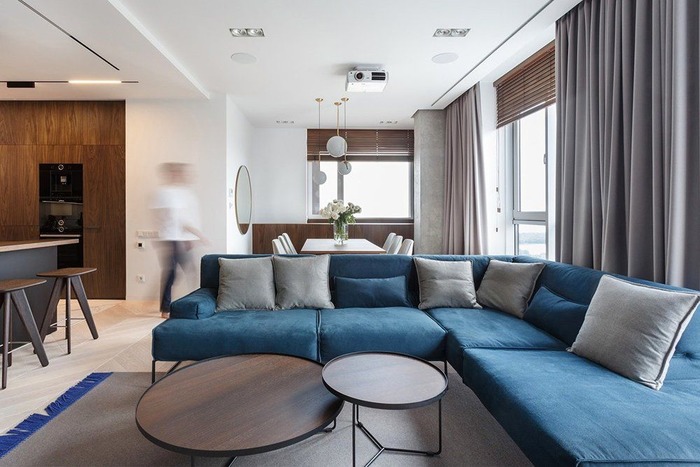
First, let's understand the concepts. The main one is illumination (denoted by the letter E, measured in lux). This is the ratio of the luminous flux incident on the surface (F, measured in lumens) to the area of \u200b\u200bthe given surface (S, sq. M). However, it should be borne in mind that in a real room, part of the light flux does not reach the working surfaces, being scattered on the walls. Therefore, in calculating the illumination of a particular room, a correction factor η is used. As a result, the formula looks like this:
E=F/S*η
We figured out the concepts, now we need a table with illumination standards. According to generally accepted GOSTs and SNIPs, the illumination standards are as follows:
Of course, you can argue with the norm for the bathroom, for applying makeup and shaving 50 Lx is not enough, you can safely increase it to 100 Lx.
Now let's finally calculate how many lamps are needed to properly illuminate, say, a bright kitchen-living room of 20 square meters. Let's say a Lumita Iris lamp with a power of 9W is selected for lighting.

Let's summarize the data:
Room area. S=20 square meters.
Light flux. Luminous flux of the Iris lamp: F = 700 Lm.
Correction factor. The share of light η that reaches the working surfaces of the room, according to rough estimates, is about half. Thus, for calculation, we can take the coefficient η = 0.5
We substitute the values to find out the illumination that 1 lamp provides: E=700 lx/20 sq. m*0.5
It turns out one lamp Iris gives illumination of 17.5 Lx. According to the norm - 150, we divide 150 by 17.5 - for sufficient illumination of a 20-meter room, 9 lamps will be needed. It is better to take 10 - they will be placed symmetrically on the ceiling, while not "overexposure" the space.
So, knowing the area of \u200b\u200bthe room and the luminous flux of the selected device, you can calculate the required number of lamps in a minute.
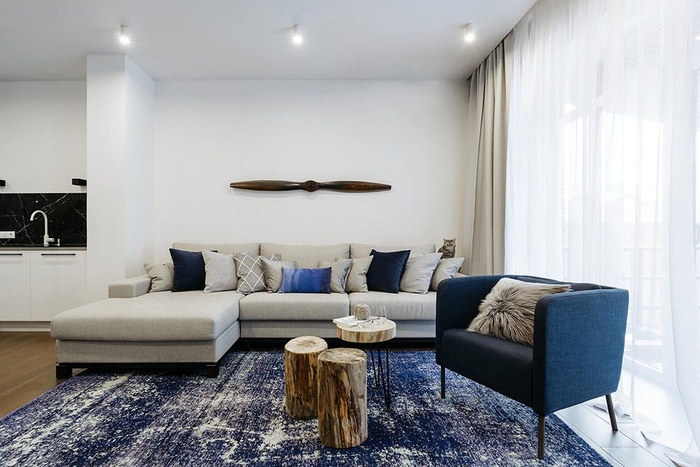
Our practice of lighting residential premises has shown that luminaires with a power of 7-9 W are suitable for a bathroom, laundry room, bathroom. For the living room, kitchen, bedroom, corridor, hall, dressing room - 9-15 W, for the nursery and study - 12-15 W. If you have a large space and high ceilings, choose even more lamp power - 12-20 watts.
Or you can not waste time on calculations at all, but write to us - we will prepare an accurate calculation with the visualization of each room in a special Dialux program. In this case, there will definitely not be a single unlit corner left.
To understand how many fixtures to buy, you will need the following parameters:
1. Room illumination standards
2. Room size
3. Parameters of the selected luminaire (luminous flux).
First, let's understand the concepts. The main one is illumination (denoted by the letter E, measured in lux). This is the ratio of the luminous flux incident on the surface (F, measured in lumens) to the area of \u200b\u200bthe given surface (S, sq. M). However, it should be borne in mind that in a real room, part of the light flux does not reach the working surfaces, being scattered on the walls. Therefore, in calculating the illumination of a particular room, a correction factor η is used. As a result, the formula looks like this:
E=F/S*η
We figured out the concepts, now we need a table with illumination standards. According to generally accepted GOSTs and SNIPs, the illumination standards are as follows:
| Room type | Illumination standards, Lux |
|---|---|
| Living room, kitchen | 150 |
| Children's room | 200 |
| Bathroom, bathroom, shower room, apartment corridors and halls | 50 |
| Dressing Room | 75 |
| Study, library | 300 |
| Stair | 20 |
Of course, you can argue with the norm for the bathroom, for applying makeup and shaving 50 Lx is not enough, you can safely increase it to 100 Lx.
Now let's finally calculate how many lamps are needed to properly illuminate, say, a bright kitchen-living room of 20 square meters. Let's say a Lumita Iris lamp with a power of 9W is selected for lighting.
Let's summarize the data:
Room area. S=20 square meters.
Light flux. Luminous flux of the Iris lamp: F = 700 Lm.
Correction factor. The share of light η that reaches the working surfaces of the room, according to rough estimates, is about half. Thus, for calculation, we can take the coefficient η = 0.5
We substitute the values to find out the illumination that 1 lamp provides: E=700 lx/20 sq. m*0.5
It turns out one lamp Iris gives illumination of 17.5 Lx. According to the norm - 150, we divide 150 by 17.5 - for sufficient illumination of a 20-meter room, 9 lamps will be needed. It is better to take 10 - they will be placed symmetrically on the ceiling, while not "overexposure" the space.
So, knowing the area of \u200b\u200bthe room and the luminous flux of the selected device, you can calculate the required number of lamps in a minute.
Our practice of lighting residential premises has shown that luminaires with a power of 7-9 W are suitable for a bathroom, laundry room, bathroom. For the living room, kitchen, bedroom, corridor, hall, dressing room - 9-15 W, for the nursery and study - 12-15 W. If you have a large space and high ceilings, choose even more lamp power - 12-20 watts.
Or you can not waste time on calculations at all, but write to us - we will prepare an accurate calculation with the visualization of each room in a special Dialux program. In this case, there will definitely not be a single unlit corner left.
